
Chronic Stress and the Body’s Mixed Messages
Chronic stress rarely stays contained to one part of the body. In my clinic, I may see fatigue mixed with poor sleep, irritability, brain fog, anxious tension, hormone changes, or a body that no longer recovers very well after a demanding week.
Most people assume that one gland or one hormone must be responsible. Cortisol and the adrenal glands usually receive most of the attention, but that is only part of the picture. Chronic stress can affect the way the nervous system, hormones, immune system, and blood sugar communicate, sometimes all at once.
Understanding those chronic stress signals helps explain why several symptoms may appear together and why the most obvious symptom does not always tell me where to begin.
Stress Can Crowd the Body’s Communication System
There is a field called psychoneuroimmunology that looks at the relationship between the mind, nervous system, hormones, and immune system. The name is a mouthful, but the concept is practical: these systems are continually exchanging information and influencing one another.
Cells receive instructions through receptors and signaling pathways. Hormones carry messages. Neurotransmitters carry messages. The immune system produces its own chemical messengers. Blood sugar changes also affect how the body responds to pressure.
These messages do not all use one shared receptor, but their signaling pathways interact. During chronic stress, cortisol, epinephrine, norepinephrine, immune activity, blood sugar changes, and hormone shifts may all be influencing the system at the same time.
The body has not forgotten how to work. It is trying to manage several priorities with a smaller margin for adjustment. That is one reason poor sleep, anxious tension, fatigue, hormone changes, and inflammation can begin showing up together.
The Adrenals May Be Responding to the Problem
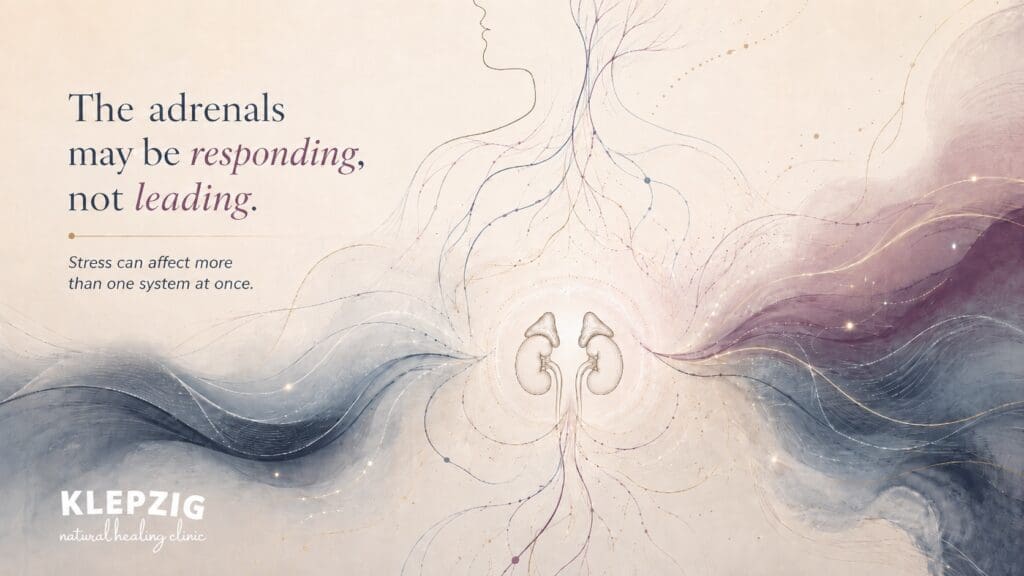
As I often tell patients, “It’s easy to point the finger at the adrenals, but more often than not, they are the victim of the stress response, not the culprit.”
The adrenal glands are an undeniable part of the stress response, but they are not always creating the original burden. Poor sleep, unstable blood sugar, inflammation, immune activity, emotional strain, food reactions, and a nervous system that will not settle can all keep asking the adrenal glands to work harder.
Poor sleep, fatigue, hormone changes, and anxious tension may look like four separate problems. During an evaluation, however, I may find that the nervous system is staying too activated, blood sugar is unstable, and the adrenal glands are compensating for both.
In that situation, simply stimulating the adrenal glands would not make much sense. I would want to settle the nervous system, improve the basic physiology, and then observe how the hormone and energy patterns respond.
Someone else may have almost the same symptoms but show more immune stress underneath the adrenal pattern. The symptoms overlap, but the reason the adrenal glands are working so hard is different. That is what gets missed when every stressed person receives the same answer.
The Central Nervous System Changes the Pattern
The natural health world tends to concentrate heavily on the adrenal glands. Conventional care usually focuses more on the brain and central nervous system. I think we need to look at both.
During an evaluation, I may compare patterns involving cortisol, epinephrine, and norepinephrine. When norepinephrine appears to be more central to the stress response, I look more closely at the nervous system side of the picture.
That person may feel tense, restless, irritable, mentally worn out, or unable to settle even though they are exhausted. Their system remains internally activated. That is a different pattern from someone whose primary problem is depletion and low reserve.
Both people may say, “I’m stressed,” but those three words do not tell me enough to choose the same nutritional or herbal support for both.
The Immune System Is Part of the Conversation
Immune activity can also influence energy, mood, hormone signaling, inflammation, and nervous-system tone. A chronic inflammatory pattern, food reaction, old infection, or hidden immune burden may keep adding pressure even when someone does not feel acutely sick.
This is also why I do not automatically consider “I never get sick” proof that the immune system is functioning perfectly. Sometimes the immune system is responding efficiently. In other cases, it may not be producing a strong, noticeable response to something the body has been tolerating quietly.
I explain immune regulation more fully in Immune Balance: Why Stronger Isn’t Always Better. This article looks at why underactive, overactive, and poorly regulated immune patterns require different kinds of support.

How Advanced Energy Medicine Helps Me Narrow the Pattern
I am not only looking for the loudest symptom. I want to know which system appears to be driving the pattern and which systems are compensating.
In my clinic, I use a hands-on advanced Energy Medicine evaluation to observe how the body responds when I check different organs, glands, foods, nutrients, stressors, and energetic information. I combine that with the person’s health history, symptoms, nutrition, and outside testing when it adds useful information.
“My technique allows me to shoot more with a rifle than with a shotgun.”
A shotgun approach throws a little bit of everything at the problem and hopes something lands. I would rather narrow the pattern, support the most useful priority, observe the response, and then decide what deserves attention next.
You can read more about the assessment process in our article on How Energy Medicine Testing Works.
Whole Food and Herbal Support
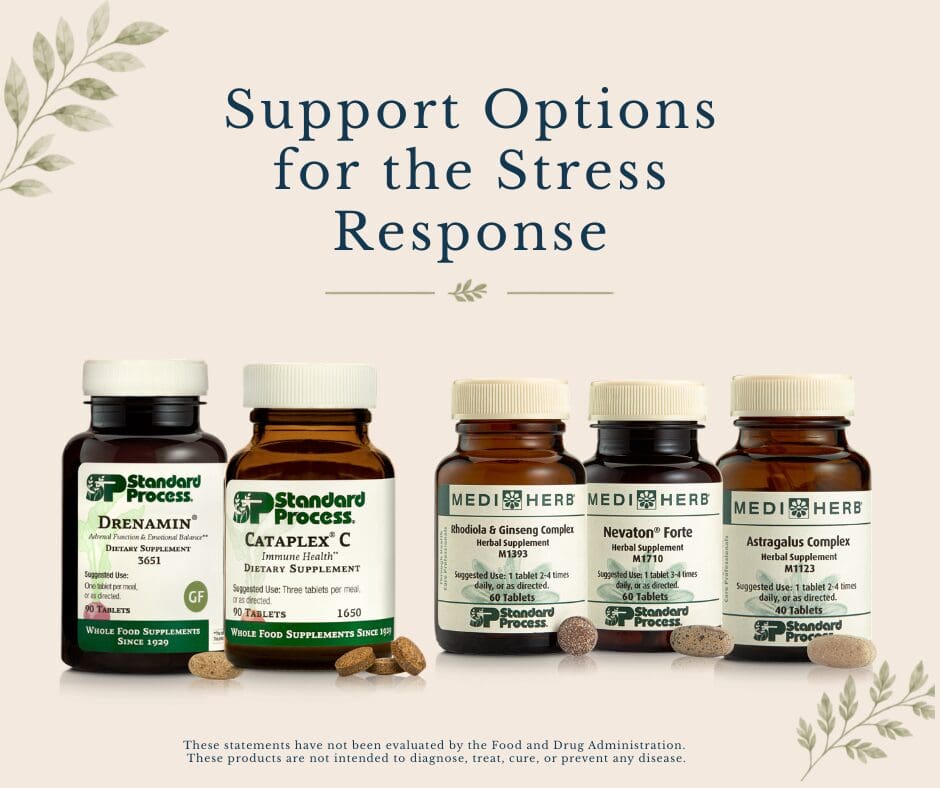
At Klepzig Natural Healing Clinic we specialize in personalized clinical nutrition. The products I consider depend on what smy evaluation shows for each individual patient. The products below support different parts of the stress picture.
Standard Process Drenamin provides broad nutritional support for healthy adrenal gland function and occasional stress. I may think about Drenamin when the adrenal glands need nutritional support, especially when the body does not appear ready for a stronger herbal push.
Standard Process Cataplex C supports normal immune function, connective tissue, healthy blood vessels, bone tissue, and healthy adrenal gland function. I include it in this discussion because prolonged stress can increase the nutritional demands placed on the adrenal glands and tissues throughout the body.
MediHerb Rhodiola & Ginseng Complex is an adaptogenic tonic used to support vitality, stamina, mental clarity, energy, and physical endurance. I think about it when the pattern calls for more daytime drive and stamina, not automatically when someone is already internally revved up.
Shop Rhodiola & Ginseng Complex
MediHerb Nevaton Forte contains Skullcap, St John’s Wort, Schisandra, and Saffron to support healthy nervous-system function and mood balance. It belongs in a different conversation from simple adrenal nutrition and may fit when the central nervous system appears to be carrying more of the stress pattern.
MediHerb Astragalus Complex combines Astragalus, Echinacea purpurea root, and Eleuthero to provide adaptogenic immune-system support. I think about this formula when stress response and immune resilience overlap rather than treating those as two completely separate issues.
These products illustrate why the pattern matters. The goal is not to collect everything labeled for stress. The goal is to understand whether the primary need is nutritional adrenal support, nervous-system support, stamina, immune resilience, or some combination.
For a deeper product comparison, read Adaptogens for Stress: Matching Support to the Pattern.
Chronic Stress Is More Than a Cortisol Number
Hormone testing and blood work can provide useful information, but one number does not always explain why someone feels the way they do. Chronic stress signals may involve the adrenal glands, central nervous system, immune system, blood sugar, and hormone communication at the same time.
My job is to sort through that information and determine what appears to be carrying the greatest load. Once the pattern is clearer, nutritional and herbal support can be selected with more purpose instead of taking the shotgun approach and hoping something sticks.
This content is for educational purposes only and is not intended to diagnose, treat, cure, or prevent any disease.
Let’s see what we can accomplish together.
Dr. Brian Klepzig
Join Our Natural Healing Community
Subscribe below to receive vital insights on holistic health, clinical nutrition, and natural wellness. We share our latest articles directly to your inbox to help support your healing journey.