

Why Your Body Loses Balance: Understanding the Weakest Link in Your System
When a new patient walks into my office, they usually come in with a sense that something in their body has drifted out of balance. They can feel the changes, even if the exact cause is unclear. What I look for are the patterns underneath the symptoms, the places where the body has been compensating for too long, and the organ or system that has been carrying most of the strain. This is often why your body loses balance in the first place. That starting point tells us where the body needs support so we can begin restoring balance and vitality.
In a recent Vital Insights blog, I explained how I use Energy Medicine testing to identify where your system is under the most stress and where we need to begin. This next step is understanding why those imbalances develop in the first place and how the body shifts out of balance over time.
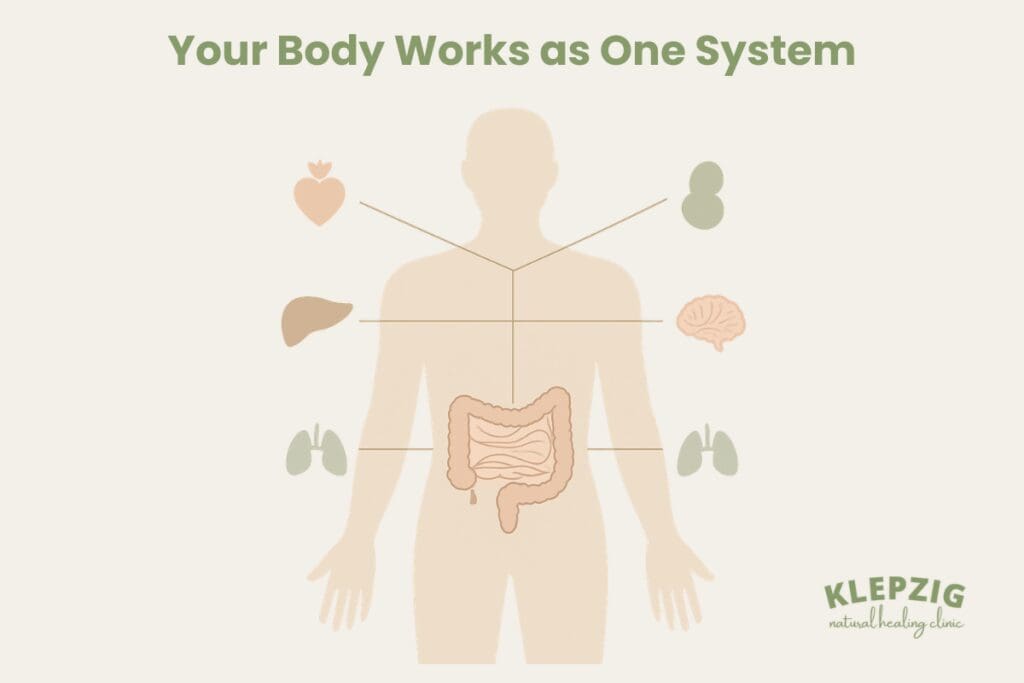
Your Body Works as a Single, Connected System
Western medicine tends to divide the body into parts. You have a doctor for your heart, one for your joints, another for your hormones, and so on. The problem is that your physiology does not operate in separate rooms. Every gland, organ, and tissue relies on the others to stay balanced.
In the approach I use at Klepzig Natural Healing Clinic, I look at the body as an energetic and physiological whole. If one organ or system is struggling, the rest of the body makes adjustments. These adjustments work for a while. Then they turn into compensations. Eventually those compensations turn into symptoms. By the time you feel the symptoms, the problem has already been building for months or years.
This is why finding the weakest link matters. It gives us the true starting point.

What Causes the Body to Lose Balance
Most people assume their main complaint is their main problem. That is rarely true. A headache might be coming from liver congestion. Anxiety might start with weak adrenal function. Fatigue might be tied to heart vitality. Digestive issues might be driven by blood sugar instability.
The weakest link is created by a combination of factors such as:
- Emotional stress
- Environmental toxins
- Chronic low grade infections
- Nutritional deficiencies
- Blood sugar swings
- Hidden food reactions
- Long term inflammation
Your body can adapt to these things for years. But eventually, the organ that has been compensating the hardest becomes the weak point in the system. Once that point falters, everything around it loses balance.
How I Identify Your Weakest Link
When I assess a patient, I use a blend of Chinese medicine principles, Western physiology, clinical nutrition, and Energy Medicine. Energy Medicine testing gives us a more advanced way to read how your body is communicating. It functions almost like an energetic blueprint and helps us see which circuits are strong and which ones are under strain. When we combine that information with physiology and nutrition, we get a far more complete picture of what your system needs. This gives us a clearer understanding of why your body loses balance, not just where symptoms are showing up.
The process usually begins with:
- Evaluating the energy charge of the major organ systems
- Checking how each organ communicates with the rest of the body
- Reviewing patterns of stress, fatigue, or stagnation
- Looking for long standing immune challenges
- Screening for nutritional gaps that weaken you over time
Through Energy Medicine testing, I can pinpoint which organ is pulling energy from the others. That is the organ we start with. Once it is supported nutritionally and energetically, it often begins to recharge the rest of the system.
If you’d like to see how this process works in real time, the short video below will walk you through exactly how I identify where the body needs support first.
Now that you’ve seen how this evaluation works, the next step is understanding what happens when we begin strengthening the system that has been carrying the most strain.
What Happens When the Weakest Link Gets Stronger
When we address the true starting point, the body can finally begin to correct itself. Balance returns. Vitality increases. Secondary symptoms often improve on their own because the system is not scrambling anymore.
This is the difference between addressing a symptom and correcting the cause.
Some patients begin to feel shifts within a few weeks. Others need more time, depending on how long the system has been compensating. But the direction is always the same. Balance first. Healing second.
Why This Approach Works to Restore Balance
Your body is not random. It follows patterns. It sends signals. It adapts until it cannot adapt any further. Understanding why your body loses balance allows us to trace symptoms back to their source.
When the foundation is strong again, everything else in the system has a chance to rise with it.
If you are tired of managing symptoms and want to understand your health from a deeper, whole body perspective, this is where your next chapter begins.
If you’d like to better understand how I identify these patterns, you can read more about my approach to Energy Medicine testing here.
Let’s see what we can accomplish together.
Dr. Brian Klepzig
Join Our Natural Healing Community
Subscribe below to receive vital insights on holistic health, clinical nutrition, and natural wellness. We share our latest articles directly to your inbox to help support your healing journey.